Embark on a journey through the world of Equity Mutual Funds, where opportunities for growth and financial security await those who dare to explore.
Discover the ins and outs of this investment option that has the potential to shape your financial future.
Introduction to Equity Mutual Funds
Equity mutual funds are investment vehicles that pool money from multiple investors to invest in a diversified portfolio of stocks. Unlike other types of mutual funds, equity mutual funds primarily focus on investing in stocks of companies, offering investors the opportunity to participate in the potential growth of the equity markets.
Benefits of Investing in Equity Mutual Funds
- Diversification: Equity mutual funds provide investors with a diversified portfolio of stocks, reducing individual stock risk.
- Potential for Higher Returns: Investing in equity mutual funds offers the potential for higher returns compared to other types of investments.
- Professional Management: Equity mutual funds are managed by experienced fund managers who make investment decisions on behalf of investors.
- Liquidity: Investors can easily buy and sell equity mutual fund units, providing liquidity compared to directly investing in individual stocks.
Top-Performing Equity Mutual Funds in the Market
| Fund Name | 1-Year Return | 3-Year Return |
|---|---|---|
| ABC Equity Fund | 20% | 15% |
| XYZ Growth Fund | 18% | 12% |
Types of Equity Mutual Funds

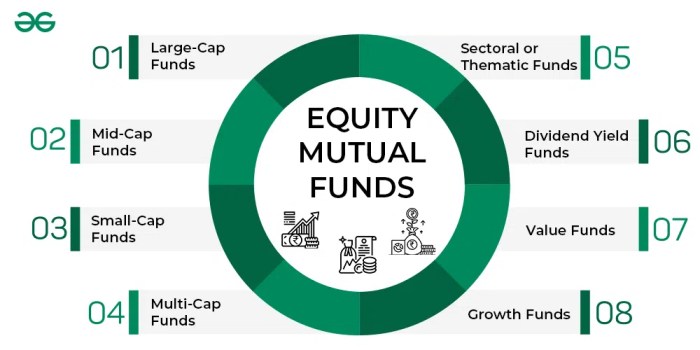
Equity mutual funds can be categorized into various types based on the type of stocks they invest in. Each type of equity mutual fund comes with its own risk-return profile, catering to different investor preferences and goals.
Large-Cap Funds
Large-cap equity mutual funds primarily invest in companies with large market capitalization. These funds are considered less risky compared to mid-cap and small-cap funds due to the stability of large-cap stocks. Investors looking for steady returns and lower risk often opt for large-cap funds.
Mid-Cap Funds
Mid-cap equity mutual funds invest in companies with medium-sized market capitalization. These funds offer a balance between growth potential and risk, making them suitable for investors with a moderate risk appetite. Mid-cap funds have the potential for higher returns compared to large-cap funds but come with higher risk.
Small-Cap Funds
Small-cap equity mutual funds invest in companies with small market capitalization. These funds have the highest growth potential among all types of equity mutual funds but also come with the highest level of risk. Small-cap funds are suitable for investors seeking high growth and are willing to tolerate higher volatility.
Sector-Specific Funds
Sector-specific equity mutual funds focus on investing in companies operating in a specific sector or industry. These funds allow investors to capitalize on the growth potential of a particular sector. However, they are more volatile compared to diversified funds as they are heavily influenced by the performance of the chosen sector.
Diversified Funds
Diversified equity mutual funds invest in a mix of large-cap, mid-cap, and small-cap stocks across various sectors. These funds offer a balanced approach, spreading the risk across different types of stocks. Diversified funds are suitable for investors looking for a well-rounded portfolio with moderate risk.
How Equity Mutual Funds Work
When it comes to understanding how equity mutual funds work, it is essential to grasp the process of pooling funds from multiple investors to invest in a diversified portfolio of equities. This allows individual investors to access a variety of stocks without having to directly buy and manage them on their own.
Role of Fund Manager
A crucial aspect of equity mutual funds is the role of a fund manager. Fund managers are responsible for making investment decisions on behalf of the mutual fund. They analyze market trends, company performance, and various other factors to strategically allocate the fund’s assets in a way that aims to achieve the fund’s objectives.
Calculation of NAV
Net Asset Value (NAV) is a key metric used in equity mutual funds to determine the value of each unit of the fund. NAV is calculated by subtracting the total liabilities from the total assets of the fund and dividing the result by the total number of outstanding units. This calculation gives investors an idea of the fund’s per-unit value at a particular point in time.
Benefits of Investing in Equity Mutual Funds
Investing in equity mutual funds can offer several benefits to investors, making them a popular choice for those looking to grow their wealth over the long term.
Potential for High Returns
Equity mutual funds have the potential to provide high returns compared to other investment options such as bonds or fixed deposits. The reason behind this is that these funds invest primarily in stocks of companies that have the potential for capital appreciation over time.
Diversification to Reduce Risk
One of the key benefits of investing in equity mutual funds is the diversification they offer. By spreading your investment across a wide range of companies and sectors, you can reduce the risk associated with investing in individual stocks. This diversification helps to cushion the impact of any underperforming stocks in your portfolio.
Tax Benefits
Investing in equity mutual funds also comes with certain tax benefits. Long-term capital gains from equity mutual funds are currently taxed at a lower rate compared to short-term capital gains or interest income from fixed deposits. Additionally, there are tax-saving equity mutual funds like ELSS (Equity Linked Savings Scheme) that offer tax benefits under Section 80C of the Income Tax Act.
Risks Associated with Equity Mutual Funds
Investing in equity mutual funds comes with certain risks that investors should be aware of. These risks can impact the performance and returns of the investment. It is essential to understand these risks before making investment decisions.
Market Risk
Market risk is one of the primary risks associated with equity mutual funds. The value of the fund can fluctuate based on the performance of the overall stock market. Factors such as economic conditions, geopolitical events, and market sentiments can affect the value of the fund. Investors may experience losses if the market experiences a downturn.
Liquidity Risk
Liquidity risk refers to the risk of not being able to sell the fund quickly at a fair price. In times of low liquidity, investors may face challenges in selling their investment at the desired price. This can be particularly problematic during market downturns when the demand for the fund decreases.
Concentration Risk
Concentration risk arises when a significant portion of the fund’s assets is invested in a specific sector or company. If that sector or company underperforms, it can have a substantial impact on the fund’s overall performance. Diversification can help mitigate concentration risk by spreading investments across different sectors and companies.
Impact of Economic Factors
Various economic factors such as inflation, interest rates, and GDP growth can influence the performance of equity mutual funds. For example, high inflation rates can erode the real returns of the fund, while low-interest rates can make it challenging to achieve significant returns. Understanding these economic factors is crucial for investors to make informed decisions.
Investing in Equity Mutual Funds vs. Individual Stocks
When it comes to deciding between investing in equity mutual funds or individual stocks, there are several factors to consider. Each option has its own set of advantages and disadvantages, making it important for investors to weigh their options carefully.
Advantages of Investing in Equity Mutual Funds
- Diversification: Equity mutual funds pool money from multiple investors to invest in a diversified portfolio of stocks, reducing the risk of individual stock volatility.
- Professional Management: Mutual funds are managed by experienced professionals who research and analyze market trends to make informed investment decisions.
- Convenience: Investing in mutual funds allows retail investors to access a diversified portfolio without the need for extensive research or monitoring of individual stocks.
- Liquidity: Mutual funds offer easy liquidity, allowing investors to buy or sell their shares at the end of each trading day.
Disadvantages of Investing in Equity Mutual Funds
- Fees and Expenses: Mutual funds charge management fees and operating expenses, which can eat into the overall returns of the investment.
- Lack of Control: Investors have limited control over the individual stocks within the mutual fund portfolio, as investment decisions are made by the fund manager.
- Market Risk: While diversification helps reduce risk, equity mutual funds are still subject to market fluctuations and overall economic conditions.
Cost-Effectiveness and Convenience of Investing in Equity Mutual Funds
Investing in equity mutual funds can be cost-effective for retail investors, as the fees are typically lower compared to actively trading individual stocks. Additionally, the convenience of having a professionally managed portfolio without the need for constant monitoring makes it an attractive option for those looking to invest in the stock market without the time or expertise to manage a portfolio of individual stocks.
Mutual Funds Overview
Mutual funds are investment vehicles that pool money from multiple investors to invest in a diversified portfolio of stocks, bonds, or other securities. They are managed by professional fund managers who make investment decisions on behalf of the investors.
Types of Mutual Funds
There are different types of mutual funds besides equity funds, including:
- Debt Funds: Invest in fixed-income securities like bonds, treasury bills, and other debt instruments.
- Hybrid Funds: Invest in a mix of stocks and bonds to provide a balanced portfolio.
- Index Funds: Mirror a specific stock market index and aim to replicate its performance.
Role of SEBI in Regulating Mutual Funds
The Securities and Exchange Board of India (SEBI) is the regulatory body that oversees the mutual fund industry in India. SEBI regulates mutual funds to protect the interests of investors, ensure transparency, and maintain the integrity of the market. It sets guidelines and regulations for mutual fund operations, disclosures, and investor protection.
As we wrap up our exploration of Equity Mutual Funds, remember that informed decisions today can pave the way for a prosperous tomorrow. Dive in and let your money work for you.
Frequently Asked Questions
What are the tax benefits of investing in Equity Mutual Funds?
Investing in Equity Mutual Funds can offer tax benefits like exemption on long-term capital gains tax after a certain period.
How is NAV calculated for Equity Mutual Funds?
NAV (Net Asset Value) for Equity Mutual Funds is calculated by subtracting the liabilities from the total value of assets and dividing the result by the number of outstanding units.