With ETFs vs Mutual Funds at the forefront, this paragraph opens a window to an amazing start and intrigue, inviting readers to embark on a storytelling journey filled with unexpected twists and insights. Here, we delve into the complexities and nuances of these investment vehicles to help you make informed decisions.
Exploring the intricate details of ETFs and Mutual Funds, we uncover the contrasting features that set them apart in the financial landscape. From expense ratios to tax implications, we unravel the mysteries surrounding these popular investment options.
ETFs vs Mutual Funds
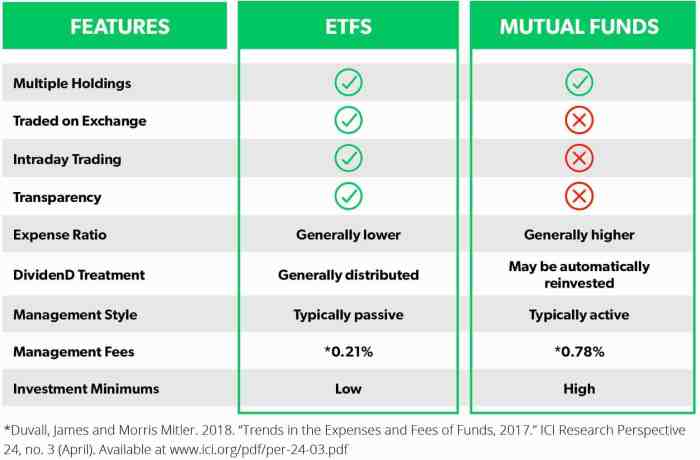
ETFs and Mutual Funds are both popular investment options, but they have key differences that investors should consider before choosing where to put their money. ETFs, or Exchange-Traded Funds, are traded on stock exchanges like individual stocks, while Mutual Funds are actively managed pools of money invested in a variety of securities. Let’s delve into the distinctions between these two investment vehicles.
Expense Ratios
Expense ratios play a crucial role in determining the cost of investing in ETFs and Mutual Funds. ETFs typically have lower expense ratios compared to Mutual Funds, making them a more cost-effective option for investors. For example, popular ETFs like SPDR S&P 500 ETF Trust (SPY) and Vanguard Total Stock Market ETF (VTI) have expense ratios as low as 0.03% and 0.03%, respectively.
On the other hand, Mutual Funds such as the Fidelity Magellan Fund (FMAGX) may have expense ratios ranging from 0.50% to 1.00% or more.
Tax Implications
When it comes to tax implications, ETFs are generally more tax-efficient than Mutual Funds. ETFs typically have lower capital gains distributions due to their unique structure, which can lead to reduced tax liabilities for investors. On the contrary, Mutual Funds are required to distribute capital gains to shareholders, potentially resulting in higher tax obligations. Investors looking to minimize tax consequences may find ETFs more favorable in this regard.
ETFs
ETFs, or Exchange-Traded Funds, are investment funds that are traded on stock exchanges similar to individual stocks. They combine the features of mutual funds and stocks, offering investors a diversified portfolio of assets that can be bought and sold throughout the trading day.
Structure and Trading
ETFs are structured as open-ended investment funds, meaning they can issue and redeem shares based on investor demand. These shares are traded on stock exchanges, allowing investors to buy and sell them at market prices during trading hours. This structure provides liquidity and flexibility to investors, as they can enter or exit their positions easily.
Creating and Redeeming Shares
The process of creating and redeeming shares in an ETF is known as the creation and redemption mechanism. Authorized Participants (APs), typically large financial institutions, can create new shares of an ETF by delivering a basket of securities to the fund’s custodian. In exchange, they receive an equivalent value of ETF shares. Similarly, APs can redeem ETF shares by returning them to the fund in exchange for the underlying securities.
Advantages of ETFs
One of the key advantages of ETFs is the ability to trade them intraday, allowing investors to take advantage of market movements throughout the day. Additionally, ETFs offer transparency in their holdings, as they are required to disclose their portfolio composition daily. This transparency gives investors a clear view of what assets they are investing in.
Tracking Indices and Sectors
ETFs can track various indices or sectors by holding a portfolio of securities that mirrors the performance of the underlying benchmark. This allows investors to gain exposure to specific markets or industries without having to buy individual stocks. By investing in an ETF that tracks a particular index, investors can achieve diversification and potentially lower costs compared to actively managed funds.
Mutual Funds
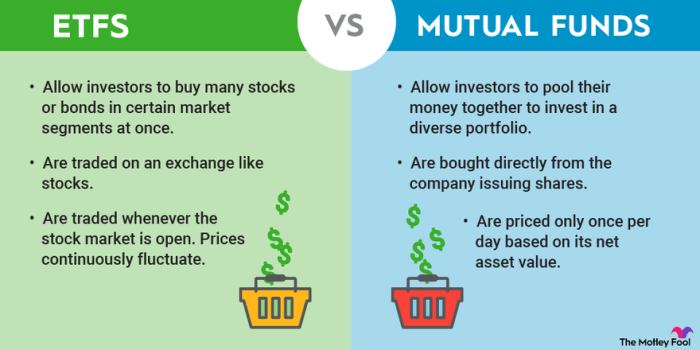
Mutual funds are investment vehicles that pool money from multiple investors to invest in a diversified portfolio of securities. They are managed by professional fund managers who make investment decisions on behalf of the investors.
Types of Mutual Funds
- Index Funds: These funds aim to replicate the performance of a specific market index, such as the S&P 500, by holding the same securities in the same proportions.
- Actively Managed Funds: These funds are managed by professionals who actively buy and sell securities in an attempt to outperform the market.
Role of Fund Managers in Mutual Funds
Fund managers play a crucial role in selecting securities, managing risk, and optimizing the portfolio for performance. Their decisions can significantly impact the overall returns of the mutual fund.
Historical Performance of Mutual Funds
Mutual funds have shown mixed performance historically when compared to ETFs. While some actively managed funds have outperformed the market, others have underperformed due to higher fees and expenses.
Pricing and Trading of Mutual Funds
Mutual funds are priced and traded once a day after the market closes. The price, known as the net asset value (NAV), is calculated based on the closing prices of the securities in the fund’s portfolio. Investors can buy or sell mutual fund shares at the NAV price.
Risks and Considerations
When it comes to investing in ETFs and Mutual Funds, it is important to consider the risks associated with each investment vehicle. Market volatility can have different impacts on ETFs compared to Mutual Funds, and understanding how diversification is achieved through these options is crucial. Investors must also carefully assess their risk tolerance and investment goals when deciding between ETFs and Mutual Funds.
Risks Associated with ETFs and Mutual Funds
- ETFs are traded on exchanges like stocks, which can lead to price fluctuations throughout the trading day.
- Mutual Funds may have redemption fees or sales charges that can impact overall returns.
- Both ETFs and Mutual Funds are subject to market risk and may experience losses based on market conditions.
Impact of Market Volatility
- ETFs may be more susceptible to market volatility due to intraday trading, while Mutual Funds are priced at the end of the trading day.
- During periods of high volatility, both ETFs and Mutual Funds may experience increased price fluctuations.
Achieving Diversification
- ETFs typically hold a basket of securities that mimic an underlying index, providing instant diversification to investors.
- Mutual Funds may also offer diversification by investing in a variety of securities within a specific asset class or sector.
Considerations for Investors
- Investors should assess their risk tolerance and investment goals to determine whether ETFs or Mutual Funds align better with their objectives.
- ETFs may be more suitable for investors looking for lower expense ratios and intraday trading flexibility.
- Mutual Funds could be a better option for those seeking professional management and potentially higher yields.
In conclusion, the comparison between ETFs and Mutual Funds highlights the unique advantages and considerations investors need to weigh. Whether it’s market volatility or diversification strategies, this discussion aims to empower you with the knowledge to navigate the investment world confidently.
Detailed FAQs
What are some key differences between ETFs and Mutual Funds?
ETFs are traded on the stock exchange like individual stocks, while Mutual Funds are priced at the end of the trading day based on their net asset value.
How do ETFs and Mutual Funds impact investors in terms of tax implications?
ETFs are generally more tax-efficient than Mutual Funds due to their unique structure and redemption process.
What advantages do ETFs offer over Mutual Funds?
ETFs provide intraday trading capabilities and transparent holdings, allowing investors to react quickly to market changes.
How are Mutual Funds priced and traded throughout the day?
Mutual Funds are priced at the end of the trading day and can only be bought or sold at that closing price.


